Scientific Insulation Estimating Services
Eliminate thermal gaps and acoustic leaks. We deliver evidence-based square-footage takeoffs for mechanical wrap, insulation, and life-safety fire enclosures.



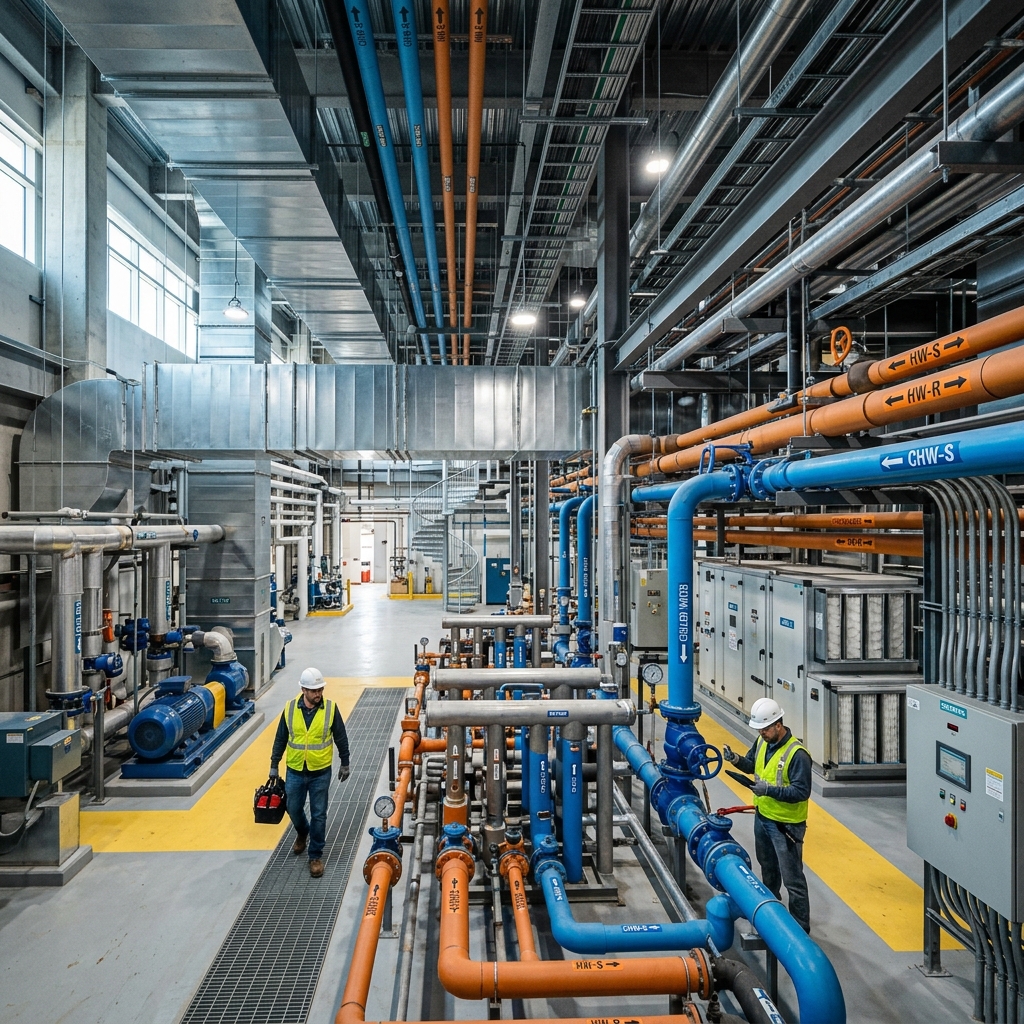
The Physics of Mechanical Protection
Insulation is not merely a wrap; it is a critical thermodynamic barrier. Observed data confirms that improper material selection leads to a 15-20% drop in system efficiency.
- Fiberglass Duct Wrap (FSK) Calculated with 25% overlap buffers to ensure vapor seal integrity across all external longitudinal seams.
- Elastomeric closed-cell Mandatory for chilled water and refrigerant lines to prevent interstitial condensation and mold growth.
- Acoustic Internal Lining Quantified by sound-absorption coefficients (NRC) to meet strict db-level requirements in healthcare and office zones.
- High-Temp Mineral Wool Dedicated takeoffs for steam and condensate lines, factoring in specialized stainless-steel banding and jacketing.
Case Study: Data Center Cooling Audit
In a Tier-4 Data Center project, we quantified 5,000 LF of fire-rated grease duct wrap and high-efficiency chilled-water insulation. By applying analytical waste factors, we identified a material discrepancy that saved the subcontractor $22k in procurement overruns.
Measuring Energy Loss, Not Just Surface Area
Observed data indicates that uninsulated mechanical systems can lose up to 35% of their thermal energy before the air or fluid reaches its final destination. Such inefficiencies are no longer acceptable under modern **ASHRAE 90.1** and IECC standards. At HVAC Estimating Services, we provide analytical HVAC insulation estimating services that treat every square foot as a variable in a larger efficiency equation.
We perform a detailed audit of R-value requirements across all unconditioned spaces. By analyzing the K-value of proposed materials against localized temperature deltas, we verify that your bid is technically sound. Data shows that 'rounding-errors' in insulation takeoffs frequently lead to a 10-15% shortage in vapor barrier tapes and mastic. We eliminate this margin erosion by applying mathematically sound waste factors to every roll of FSK wrap and every bucket of adhesive.
Our team uses high-fidelity surface area models to capture the perimeter of every rectangular run and the circumference of every round spiral duct. We provide color-coded PDF reports that allow your field crews to see exactly where the lining stops and the wrap begins. The result is a zero-defect insulation package that protects your profits while satisfying the most rigorous thermodynamic inspections.
The Scientific Takeoff Lifecycle
Thermal Spec Analysis
First, we perform a scientific audit of the R-value requirements and vapor barrier integrity levels defined in the mechanical manual.
Geometric Surface Mapping
Next, we build a 3D surface model to calculate the exact exterior square-footage of all duct and pipe vectors.
Fittings & Accessories Count
Then, we quantify every fitting cover, PVC jacket, and high-density saddle to ensure 100% component capture.
MICA Labor Calibration
Finally, we align the material totals with MICA labor standards, adjusted for project-specific congestion factors.
Trusted by Contractors Nationwide
See what industry professionals are saying about our HVAC estimating services
"HVAC Estimating Services has been a game-changer for our bidding process. Their accuracy on ductwork takeoffs has helped us win 40% more projects this year. The turnaround time is unbeatable - we get detailed estimates within 24 hours."
"We've been using their HVAC estimating services for over two years now. The level of detail in their cost breakdowns is exceptional. They've saved us countless hours and tens of thousands of dollars in material waste."
"As a small HVAC contractor, having reliable cost estimates is critical. Their team uses industry-standard tools like PlanSwift and RSMeans to deliver estimates I can trust. I recommend them to anyone in the mechanical contracting space."
"The commercial HVAC estimates we receive are incredibly thorough - piping, ductwork, equipment costs, labor - everything is accounted for. Their team truly understands construction estimating at a professional level."
Insulation Science & Compliance FAQs
Observed data indicates that thermal resistance is highly dependent on both material density and ambient humidity. We audit the project specifications against <strong>ASHRAE 90.1</strong> standards to verify that the proposed insulation thickness (e.g., 1.5" vs 2" wrap) meets the required R-value for the specific building zone. This prevent energy-code failures during the final inspection phase.
Yes. Data shows that closed-cell elastomeric insulation (like Armaflex) is mandatory for chilled water systems to prevent sub-surface condensation. We isolate these materials in our reports, applying specific labor modifiers for the specialized adhesives and joint-sealing required for non-fibrous applications.
Thermal bridging often occurs at hanger points where insulation is compressed. We factor in high-density localized inserts (shields and saddles) in our BOM. Our surface area formulas include a mathematically derived 'compression-buffer' to ensure that the raw material ordered satisfies the physical installation geometry without thinning the thermal barrier.
We perform dedicated audits for life-safety systems including 2-hour fire-rated wraps (e.g., 3M Fire Barrier). These systems require multi-layer overlapping which we quantify at the linear-inch level. Our evidence-based approach ensures that high-cost fire-wrap is never underestimated.
Internal lining reduces the available cross-sectional area of a duct. We provide a dual-data report: the raw sheet metal dimensions for the shop and the net airflow dimensions for the balancer. This ensures the system performs to the design CFM while maintaining acoustic db suppression targets.
Integrated Estimating Solutions
Ductwork Estimating
Technical measurement and quantification of sheet metal ductwork and SMACNA fabrication.
Learn MorePiping Estimation
Accurate takeoffs for all mechanical piping systems, including chilled water and steam lines.
Learn MoreCommercial HVAC
Large-scale mechanical takeoffs for offices, hospitals, and high-rise developments.
Learn More